Showing posts with label Iran. Show all posts
Showing posts with label Iran. Show all posts
Thursday, September 27, 2012


Tuesday, September 25, 2012
Wednesday, September 22, 2010
Ahmadinejad vs. Capitalism...Oh Really?
Although some of dangers of capitalism being too unregulated and very globalized were exposed when the sub-prime housing crisis impacted not only the U.S. but other countries with international investment portfolios, Ahmadinejad's statement against capitalism seems ironic, since Sepah (Revolutionary Guards) are taking over more and more businesses in Iran, already reportedly reaps huge profits off black market items in Iran, and arrests so many people and demands such huge bail that it's starting to look like an extortion racket. Also, the Islamic regime famously persecuted the Communists who helped them come to power.
So is this the best that AN could come up with as a theoretical counter-attack to the more severe economic sanctions that have been put in place against the IRI?
http://news.yahoo.com/video/world-15749633/22013125Ahmadinejad Lashes Out at Capitalism
Thursday, September 16, 2010
IRI can track Haystack proxy users
Frankly, there are already other proxy servers that internet users in Iran are using safely. I don't see why Haystack was even needed. Now it turns out Haystack may have endangered users. Very sad. Not good.
Tor developer criticizes Haystack http://www.wired.com/threatlevel/2010/09/haystack
Monday, September 13, 2010
Yazdi: prison rape spiritual equivalent of pilgrimage to Mecca
 Grand ayatollah Yazdi is beyond extreme. I hope he does not gain even more power after Khamenei dies.
Saturday, September 11, 2010
ATTN: Mr. Democrat director receives award from Secretary of State Hillary Rodham Clinton

The sharp truths in Farbod "Fred" Khoshtinat's ATTN: Mr. Democrat video are almost shocking. It's wonderful to see these truths and the greatness of this video acknowledged--and by acknowledging them, the greatness of brave Iranian people who do fight and struggle against exterior and interior obstacles as they seek the way to their own kind of freedom and democracy.
Thanks again to everyone who voted and helped spread the word about this video.
Here is the video link to the Democracy Video Challenge award ceremony. Secretary Rodham Clinton mentions Iran's green movement around 4:00 and Farbod "Fred" Khoshtinat receives the award around 6:18. Here is more info about Democracy Video Challenge.
There are six winners of the 2010 Democracy Video Challenge: Anup Poudel of Nepal, Yared Shumete of Ethiopia, Farbod Khoshtinat of Iran, Joel Ben Marsden of Spain, Adhyatmika Euuy of Indonesia and Juan Pablo Patino Arevelo of Colombia.
Here is the transcript in case your computer/internet connection is too slow for video, or your country blocks YouTube.
2010 Democracy Video Challenge Award Presentation
Hillary Rodham Clinton
Secretary of State
Judith A. McHale
Under Secretary for Public Diplomacy and Public Affairs
Treaty Room
Washington, DC September 10, 2010
UNDER SECRETARY MCHALE: Come on in. These are the stars of the show, the real stars of the show. They probably feel a little uncomfortable because they’re normally on the other side of the camera. (Laughter.)
Good afternoon. I’m delighted to be here with all of you today. I’m Judith McHale and I have the great privilege of introducing you to some great filmmakers. These are the winners of our Democracy Video Challenge, which is in its second or third year that we have done this, where we reach out to young filmmakers around the world and ask them to submit videos which illustrate how they think about – the contest is called Democracy Is… and so they interpret in film, in a two-minute film, what democracy means. And it’s absolutely extraordinary. The sort of versions and interpretations of this are really incredibly well done, but also very moving. We have – obviously, all of us have an enormous commitment to democracy and to see how these young filmmakers interpret that world, I invite you all to see it.
We’re also delighted to have some of our partners here with us today, without whom we could not have done it. And I’d also especially like to thank Lori Brutten from IIP, who has organized this, the sort of State Department genius behind this, and Dawn McCall, our new head of IIP, who have joined me here today.
But most importantly, I’m delighted to have our Secretary of State, Secretary of State Hillary Clinton, with us today to say a few words about these great filmmakers. Secretary Clinton.
SECRETARY CLINTON: Thank you so much, Judith. And this is an especially exciting day for us here to celebrate these young activist filmmakers who are using technology to make their voices heard and, by doing so, giving voice to so many millions of others, and the State Department’s partners who have made the Democracy Video Challenge not only possible, but amazingly successful.
So far, over 3.5 million people around the world have been reached by our growing Democracy is… campaign. This is an effort led by Judith and her entire team to engage youth in a global dialogue on democracy. And we are about to kick off the 3rd annual Democracy Video Challenge at the United Nations next week. So I am very eager to see what ideas this continues to generate.
The prompt for this challenge, as you know, is “Democracy is…” It’s open ended. It is meant to provoke thought and to spur ideas. It truly is a challenge that builds on the freedom that democracy provides for individuals to pursue their own dreams. Each of these young winners has captured six different visions of democracy – some satirical and lighthearted, some poignant and haunting – but each shaped by their own experiences and expressed through their own unique artistic lens.
Now, not all democracies look or behave exactly the same way. As our winner from Nepal said about his video – I hope you don’t mind me quoting you – (laughter) – “Democracy can exist in all countries and it doesn’t have a fixed shape or size.” But the fundamental tenets are non-negotiable. The videos we are honoring today capture essential truths about democracy across the world and respond to the deepest yearning of human beings to have a right to their own lives and their own dreams. Democracy is about fair play. Democracy equalizes the voices of people. And democracy is a learning process.
And so I said earlier this week at a speech I gave that democracy needs defending. And I think we have a very good cross-section of defenders standing here. Another one of our winners, whose beautiful video was inspired by the Green Movement in Iran, said, “I believe if I want democracy, I should fight for it! And this is my way of fighting.” And it gives me great hope to see what these young people are saying.
Now, here at the State Department, we talk a lot about the need to use 21st century diplomacy to solve 21st century problems. Well, this is the heart of that 21st century diplomacy – connecting directly to people, particularly young people, who Judith constantly reminds me – (laughter) – represents what percentage of the world’s population? (Laughter.)
UNDER SECRETARY MCHALE: Sixty-five percent are under the age of 30.
SECRETARY CLINTON: Yeah. Boy, does that make me feel old, I gotta tell you. (Laughter.)
So this is about not only the next generation, it’s about this generation. I particularly want to welcome representatives of the countries of the winners who are here today, and thank you all for coming.
Now, Under Secretary McHale will come back to officially present the awards, which I think you will call the name and I will hand the award. Is that the way we will do it? So I will maybe come out around here, and as you call the name, if the winner will come up here, and then we can give the award. And I hope you all get pictures – that way? Is that okay? All right.
UNDER SECRETARY MCHALE: As Secretary Clinton has mentioned, these winners come from around the world, from each of the six different regions of the world, and they were voted on by people who were tuned into and watching constantly YouTube. So we also especially want to thank YouTube for helping us with this.
From Colombia, Juan Pablo Patiño. (Applause.)
From Ethiopia, Yared Shumete. (Applause.)
From Indonesia, Adhyatmika. (Applause.)
From Iran, Farbod Khoshtinat. (Applause.)
From Nepal, Anup Poudel. (Applause.)
And from Spain, Jual – I’m sorry, Joel Mardsen. (Applause.)
SECRETARY CLINTON: Well, we’re very proud of these winners and we are looking to follow them with great interest. We hope that this not only confirms their own ideas, but actually serves to generate more from them and encourage others to join their ranks. So let’s give our award winners another round of applause. (Applause.)
And Judith, why don’t we invite some of our partners and perhaps you could introduce them as well.
LORI BRUTTEN: (Inaudible), Steve Grove, the director of YouTube Student Politics; Rick Cotton, Chief Counsel of NBC Universal; Kate Raftery from the – Vice President for Learning and Citizenship at the International Youth Foundation; Patti Pearson, New York University’s Tisch School of the Arts, Director of Special Projects.
SECRETARY CLINTON: Great. (Applause.) Great. Thank you all very much.
# # #
Saturday, July 31, 2010
Strong quake jolts southeastern Iran
Mehrnews.com reports: "TEHRAN, July 31 (MNA) – An earthquake with a magnitude of 5.8 on the Richter scale struck the southeastern Iranian city of Kerman on Saturday.
The epicenter of the earthquake was the town of Negar. The quake happened at 11:22 a.m. local time, the Tehran Seismological Center said.
Saturday’s earthquake comes only a day after a 5.7-magnitude quake hit the northeast city of Torbat-e Heydariyeh at 6:20 p.m. local time injuring at least 270 people.
A powerful earthquake devastated the historic city of Bam in Kerman Province in 2003, killing about 27,000 people.
Active Tectonics at the Natanz Region, Central Iran
by F. Jamali, K. Hessami, H. Tabasi
abstract:
"This paper uses geomorphic features to constrain active structural deformation at the Natanz region, central Iran. Offset stream beds indicate rightlateral strike slip motion at a rate of about 2.5 mm/yr along the NW-SE trending Qom-Zefreh fault zone. Deep incision of the Moghar river which crosses the Charkheh and Zardkuh anticlines also indicates uplift at depth on thrust faults dipping SSW beneath the anticlines. The fact that the active Qom-Zefreh strike-slip fault runs parallel to the active fold and thrust zone suggests that oblique motion of Arabia with respect to Eurasia is partitioned in this part of central Iran. We conclude that the active blind faults which leave clear signatures in geomorphology should be seriously considered as a seismic source while assessing seismic hazard in the region."
to see full paper, go to:
http://www.iiees.ac.ir/iiees/English/Publication/Jsee/jsee19_1.html

abstract:
"This paper uses geomorphic features to constrain active structural deformation at the Natanz region, central Iran. Offset stream beds indicate rightlateral strike slip motion at a rate of about 2.5 mm/yr along the NW-SE trending Qom-Zefreh fault zone. Deep incision of the Moghar river which crosses the Charkheh and Zardkuh anticlines also indicates uplift at depth on thrust faults dipping SSW beneath the anticlines. The fact that the active Qom-Zefreh strike-slip fault runs parallel to the active fold and thrust zone suggests that oblique motion of Arabia with respect to Eurasia is partitioned in this part of central Iran. We conclude that the active blind faults which leave clear signatures in geomorphology should be seriously considered as a seismic source while assessing seismic hazard in the region."
to see full paper, go to:
http://www.iiees.ac.ir/iiees/English/Publication/Jsee/jsee19_1.html
Friday, July 16, 2010
Iranian Regime Compared to South American Dictatorships, Sepah Retreats from South Pars Oil Field, Bazaar Strikes Continue
The Wall Street Journal reports: "The engineering arm of Iran's Revolutionary Guard Corps said Friday it was pulling out of projects in a giant Iranian natural-gas field in the Persian Gulf, blaming mounting sanctions from the West.
I discussed this news with an American Liberal, Jeannette Hanna, whom I met on the Cultures of Resistance page on Facebook.
Hanna: I didn't realize that the Rev. Guard was also a business consortium. Do you believe it?
Jigsawnovich: Iranian friends have told me that the Revolutionary Guards are in control of all major industries in Iran. And I've read articles claiming that although Ahmadinejad has been "privatizing" many national Iranian businesses, in reality he is reportedly selling them to individuals who are fronts for the Revolutionary Guards, a subset of the Iranian government. My understanding is that by doing this, he puts more economic power under the Revolutionary Guards' control, while regulatory aspects within the Iranian government lose control.
I hope the US and UN sanctions are successful in reducing the power of Revolutionary Guards who have reportedly violated Constitutional rights of Iranians since the election, especially IF the Revolutionary Guards might be moving towards nuclear weapon development and might show the same disregard for others' human rights that they have shown for their own people. But whether sanctions can do this with minimal adverse impact on pro-democracy, pro-human rights, secular, Liberal Iranians, remains to be seen. The Revolutionary Guards have reportedly so deeply infiltrated the economics of Iran that friends tell me it is hard to hurt them without hurting Iranian people that international supporters of true democracy and freedom don't want to get hurt.
Hanna: Where do the religious stand on this? They wouldn't want the Rev. Guard in charge unless the Guards promised to keep them in some kind of effective role...
I suppose that one way to keep the secular elite under control would be to have them be the ones whose names are on the companies being privatized for the Guards...it then involves them, too.
Jigsawnovich: The Iranians I know who are sincere and practicing Muslims want a secular government, not a theocracy, because they believe that their government is corrupting and abusing the religion. But my friends seem to be more intellectual and more creative than some of the religious people who do support the regime.
The Revolutionary Guards and Basij characteristically recruit people who are willingly obedient to all the religious rules and people who are economically disadvantaged.
Decadent, rich Iranians reportedly bribe police and security forces when they throw wild parties and break Islamic laws. Enjoying freedoms they can afford to purchase would make them unlikely to try to force regime change. And I've been told that most of the top business owners already have a relationship with the RG. The Revolutionary Guards have seen to that in their efforts to prevent the kinds of strikes that lead to the Iranian Revolution of 1979.
That's why the bazaar strikes are significant. The bazaar merchants apparently still have some power.
I hope the US and UN sanctions are successful in reducing the power of Revolutionary Guards who have reportedly violated Constitutional rights of Iranians since the election, especially IF the Revolutionary Guards might be moving towards nuclear weapon development and might show the same disregard for others' human rights that they have shown for their own people. But whether sanctions can do this with minimal adverse impact on pro-democracy, pro-human rights, secular, Liberal Iranians, remains to be seen. The Revolutionary Guards have reportedly so deeply infiltrated the economics of Iran that friends tell me it is hard to hurt them without hurting Iranian people that international supporters of true democracy and freedom don't want to get hurt.
Hanna: Where do the religious stand on this? They wouldn't want the Rev. Guard in charge unless the Guards promised to keep them in some kind of effective role...
I suppose that one way to keep the secular elite under control would be to have them be the ones whose names are on the companies being privatized for the Guards...it then involves them, too.
Jigsawnovich: The Iranians I know who are sincere and practicing Muslims want a secular government, not a theocracy, because they believe that their government is corrupting and abusing the religion. But my friends seem to be more intellectual and more creative than some of the religious people who do support the regime.
The Revolutionary Guards and Basij characteristically recruit people who are willingly obedient to all the religious rules and people who are economically disadvantaged.
Decadent, rich Iranians reportedly bribe police and security forces when they throw wild parties and break Islamic laws. Enjoying freedoms they can afford to purchase would make them unlikely to try to force regime change. And I've been told that most of the top business owners already have a relationship with the RG. The Revolutionary Guards have seen to that in their efforts to prevent the kinds of strikes that lead to the Iranian Revolution of 1979.
That's why the bazaar strikes are significant. The bazaar merchants apparently still have some power.
Homylafayette blog reports that: Pro-regime, anti-Ahmadinejad site publishes photos of bazaar strike
And here is footage from the early part of the strike, July 13, 2010
Hanna: How is it possible to be Pro-regime and Anti-Ahmadinejad? Who/What is The Regime, then?
Jigsawnovich: pro-regime = supports the current form of government in Iran
anti-Ahmadinejad = against policies enacted during the Ahmadinejad administration
Hanna: OK, thanks. Pro-regime=Approves the STRUCTURE of power, whoever is in the President's position. Anti-Ahmadinejad….Really then, policies were enacted during his admin, but he wouldn't have had the power to pass them himself. It is more of a historical description, like "during the time of Ahmad." Well, without changing the STRUCTURE....or at least the rigidity of the Supreme Leader by getting a different one, there can be no change.
I understand that even if Ahmadinejad had been allowed to lose the election to a moderate....things couldn't possibly have really changed as long as the RG was in place to follow through on the wishes of the Supreme Leader....and with their economic power....that pretty much sews things up. Am I getting it?
Jigsawnovich: It may be possible the Revolutionary Guards could become so powerful that they stop taking orders from the Supreme Leader. Iran could become a military dictatorship unrestrained by either the Supreme Leader or the Iranian Parliament, and only retaining Islam as a tool for recruiting people and keeping them under control. Ahmadinejad could be kept as the frontman, so that it looks like they still have a President instead of a military commander.
Hanna: That is exactly what I was thinking as we were writing back and forth. It was starting to look an awful lot like Chile and Argentina under military dictatorships....they didn't even have to bother with a front man. That is also how they and the top 2 % of the population ripped off the wealth of the country...privatization...and that top 2 % was complicit in the murders, economic chaos, resultant desperate poverty, destruction of the intellectuals, ownership of the media, etc.
And here is footage from the early part of the strike, July 13, 2010
Hanna: How is it possible to be Pro-regime and Anti-Ahmadinejad? Who/What is The Regime, then?
Jigsawnovich: pro-regime = supports the current form of government in Iran
anti-Ahmadinejad = against policies enacted during the Ahmadinejad administration
Hanna: OK, thanks. Pro-regime=Approves the STRUCTURE of power, whoever is in the President's position. Anti-Ahmadinejad….Really then, policies were enacted during his admin, but he wouldn't have had the power to pass them himself. It is more of a historical description, like "during the time of Ahmad." Well, without changing the STRUCTURE....or at least the rigidity of the Supreme Leader by getting a different one, there can be no change.
I understand that even if Ahmadinejad had been allowed to lose the election to a moderate....things couldn't possibly have really changed as long as the RG was in place to follow through on the wishes of the Supreme Leader....and with their economic power....that pretty much sews things up. Am I getting it?
Jigsawnovich: It may be possible the Revolutionary Guards could become so powerful that they stop taking orders from the Supreme Leader. Iran could become a military dictatorship unrestrained by either the Supreme Leader or the Iranian Parliament, and only retaining Islam as a tool for recruiting people and keeping them under control. Ahmadinejad could be kept as the frontman, so that it looks like they still have a President instead of a military commander.
Hanna: That is exactly what I was thinking as we were writing back and forth. It was starting to look an awful lot like Chile and Argentina under military dictatorships....they didn't even have to bother with a front man. That is also how they and the top 2 % of the population ripped off the wealth of the country...privatization...and that top 2 % was complicit in the murders, economic chaos, resultant desperate poverty, destruction of the intellectuals, ownership of the media, etc.

Monday, June 28, 2010
Earthquake plus nuclear facilities
Christopher Hitchens wrote in Slate: "While the "negotiations" on Iran's weaponry are being artificially protracted by an irrational and corrupt regime, it should become part of our humanitarianism and our public diplomacy to warn the Iranian people of the man-made reasons that the results of a natural calamity would be hideously multiplied in their case… earthquake plus ill-maintained covert nuclear facilities...
Tehran Nuclear Research Center is located in suburban Amirabad, according to this article.
View Larger Map
Active faults around Tehran — courtesy of IIEES:
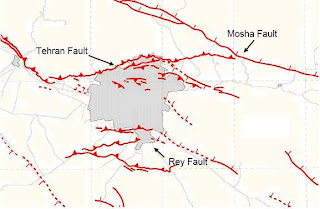


Iran fault activity — courtesy of IIEES:

Tehran Nuclear Research Center is located in suburban Amirabad, according to this article.
View Larger Map
Active faults around Tehran — courtesy of IIEES:


Iran seismic hazard map — courtesy of IIEES:

Iran fault activity — courtesy of IIEES:

Sunday, June 27, 2010
Warships Stationed Off Iranian Coast
http://rawstory.com/rs/2010/0627/report-warships-stationed-iranian-coast/
Will Iranian rocker's "Ships" music video prove eerily prophetic?
Wednesday, June 23, 2010
The Free Keys rock "Ships"

by Julie Jigsawnovich
CNN iReport--The Free Keys emerged from Tehran's music underground to international acclaim when they were featured in the Cannes award winning film, No One Knows About the Persian Cats. Not approved by the Ministry of Culture and Islamic Guidance, The Free Keys fled to Pune, India where they’ve now legally released the track, "Ships."
The unusual time signature, enticing riff and mischievous vocals beckon like some kind of rock siren across the waves in moonlight. Reverberating echoes loop back on themselves, reaching critical mass. Suddenly one feels like the floor is collapsing--and one is falling down, down to the bottom of the sea.
Some enjoy the sensation of falling, skydiving, high diving. But "Ships" does not convey simple thrills. It’s something deeper, more primal, more real—akin to the sinking feeling that something is deeply wrong and terrible events may be about to transpire.
Such keyed-up emotion is not surprising given that the The Free Keys received international exposure just as the regime was about to crack down. But “Ships” could be topical within the larger context. The Islamic Republic debuted its first domestically built destroyer warship earlier this year. More Israeli nuclear submarines have reportedly headed for the Persian Gulf amidst international speculation over potential Iranian blockades of the Strait of Hormuz in retaliation for increased sanctions and threatened ship inspections. Hundreds of "bunker buster" deep penetration bombs were reportedly shipped to the U.S. base on Diego Garcia in the Indian Ocean south of Iran. And a few days ago Egypt allowed at least one Israeli and 11 American warships to pass through the Suez Canal reportedly headed towards Iran or U.S. ally, Pakistan. After all, just as the U.S. was passing "crushing sanctions", Tehran signed a $7 billion agreement inaugurating the construction of a gas pipeline from Iran to Pakistan.
I asked The Free Keys' lead guitarist, Arya, whether the song is about war ships. He replied, "Ha ha, no. Actually it was merely a coincidence that we noticed too. 'Ships' is the title of our friend Rajan Virdee's poem that we used as lyrics. It's about a brewing love--and how in the abstract love has a strictly narcissistic motive behind it. One line in the poem says:
'But if such love is conjured under one spot-light
it's just as easily lost in despising and spite
like two ships crashing and burning in the night.'"
Ships launched by proud nations with complex, intertwined histories may approach each other soon. Will there be an engagement making The Free Keys' new track eerily prophetic? The music video for “Ships” is reminiscent of torpedoes and explosions.
Currently The Free Keys are offering listeners the opportunity to access this track for free. Arya continued, "The song is available for free download because it's a prototype version. Obviously the album version won't be. You can download it on www.4shared.com/audio/zfRkRRL2/Ships.html "
Thursday, June 17, 2010
Don't let corporations become dictators
 by Julie Jigsawnovich
Although the dictatorial regime running the Islamic Republic diligently tries to block Iranians from watching YouTube, the color of Iran on the map proves that many Iranians are finding proxies to access the full internet.
Unfortunately, there's an even bigger threat to internet freedom--not from governments, but from corporations. Corporations could be even more effective than governments at preventing users from choosing what to view.
As Megan Tady wrote in the Huffington Post,"While the Internet allows people to create and share their work with the world without anyone's permission, phone and cable companies like Comcast and AT&T want to control the Internet - deciding which content loads fast, and which doesn't load at all. They could effectively silence artists and media makers everywhere, and you, too."
In addition to the strong grassroots support ATTN: Mr. Democrat received through social networks and private emails--Iranian, Azerbaijanian, French and American writers have embedded the video in their blogs. Plans by Comcast and AT&T to control the internet particularly endanger bloggers and small website owners who support democracy.
As the internet has become a central form of communication, internet freedom/net neutrality is vital to democracy. Don't let corporations become dictators. This issue is urgent, and the impact would be international. Please contact the FCC (Federal Communications Commission) and President Obama, strongly urging them to protect free expression on the Internet--so that we can keep using the Internet the way we want to.
People living in the U.S. can
contact the FCC through email here.
Everyone can contact President Obama.
Everyone can thank these Senators for their support.
I recommend the following advocacy group for this issue: www.savetheinternet.com
This article was republished at: www.savetheinternet.com/story/30631
Everyone can contact President Obama.
Everyone can thank these Senators for their support.
I recommend the following advocacy group for this issue: www.savetheinternet.com
This article was republished at: www.savetheinternet.com/story/30631
Sunday, June 13, 2010
Iranian and Israeli Filmmakers in close competition
FOR IMMEDIATE RELEASE
Farbod Khoshtinat's short film, ATTN: Mr. Democrat, has been selected by judges for the Democracy Video Challenge to represent Iran in the final round of this competition. Khoshtinat's short is competing with videos from Israel and Algeria in the Near East category, one of six geographic divisions. Winners will be decided by "thumbs up" votes cast by signed in YouTube users who view the video via www.youtube.com/democracychallenge. One vote per video may be cast each day through June 15, 2010.
How to vote for ATTN: Mr. Democrat
How to vote for ATTN: Mr. Democrat
Sign In to your YouTube account
Go to www.youtube.com/democracychallenge
Click on VOTE, search for ATTN: Mr. Democrat
Click on green thumbs up to vote
Go to www.youtube.com/democracychallenge
Click on VOTE, search for ATTN: Mr. Democrat
Click on green thumbs up to vote
YouTube Google analytics maps under the videos reflect the countries from which votes for the videos are cast. Countries grow greener as more votes are cast. The map for Khoshtinat's video (at www.youtube.com/watch?v=KI6oOgG-HRg ) shows far broader geographic support. Although some of the votes credited to the US and Canada could be due to proxy servers helping Iranians to access full internet despite the Iranian government's blockade against YouTube, voters in Russia, Scandinavia, Africa and Israel are also showing support for ATTN: Mr. Democrat. Wide support should come as no surprise because it is an exceptionally well written, highly artistic and beautifully scored short film--and because there are people all over the world who support freedom and fair elections.

Khoshtinat is no mere student. He edited the music video sequences for the Cannes award-winning film, No One Knows About the Persian Cats. And the music video Khoshtinat made for Iranian rapper Hichkas' Ye Mosht Sarbaz has received over 200,000 views on YouTube. Khoshtinat was a teenager in Tehran when he made Hichkas' video under the pseudonym "Fred" in hopes of evading arrest for promoting Western music in violation of Iran's strict Islamic laws.
As of June 13, 2010, 3:19am, Khoshtinat's upload of ATTN: Mr. Democrat has received 10,912 views on YouTube. But because several thousand of those views took place before the May 15th beginning of the final round of this competition, many of those views could not be counted as votes. The closest competitor, Democracy Is… video by Israelis Tomer Zemel, Maria Levitin and Orit Englander received 7,042 views as of 3:19am June 13, 2010. But at least 5,000 of these views took place after the video was embedded on Russian websites www.newsru.co.il, www.newsru.com, www.sem40.ru, and was covered by Israeli journalists online and in Israeli newspapers.
The winner of this competition will receive an all-expense-paid trip to Washington, D.C., New York and Hollywood, gala screenings of the winning videos in Hollywood, New York and Washington, exposure to filmmakers and the U.S. film and television industry, and meetings with democracy advocates from government, media and civil society.
How to vote for ATTN: Mr. Democrat
Sign In to your YouTube account
Go to www.youtube.com/democracychallenge
Click on VOTE, search for ATTN: Mr. Democrat
Click on green thumbs up to vote
For additional information about ATTN: Mr. Democrat and about director Farbod Khoshtinat please contact Media Advisor Julie Jigsawnovich at Jigsawnovich1 (at) gmail.com
Go to www.youtube.com/democracychallenge
Click on VOTE, search for ATTN: Mr. Democrat
Click on green thumbs up to vote
For additional information about ATTN: Mr. Democrat and about director Farbod Khoshtinat please contact Media Advisor Julie Jigsawnovich at Jigsawnovich1 (at) gmail.com
Friday, June 11, 2010
Former elite officers in Revolutionary Guard reveal increasing tensions in Iran regime
http://www.guardian.co.uk/world/video/2010/jun/11/iran-revolutionary-guard-defectors
A two-month investigation by Guardian Films and the Bureau of Investigative Journalism reveals how hundreds of members of Iran's Revolutionary Guard are defecting - in protest at what they see as a 'betrayal' by the Iranian government
Tuesday, June 1, 2010
Friday, May 21, 2010
Wednesday, May 19, 2010
Iranian Lesbian Denied Asylum in UK

Petition to To save Kiana Firouz's life by stopping her deportation from UK
TimesOnline reports: "A young Iranian actress named Kiana Firouz will attend the London premiere tonight of a film in which she plays a lesbian seeking asylum in Britain because the Iranian authorities are pursuing her. The Home Office rejects her application and sends her back to the Islamic republic, where homosexuality is a crime punishable by death.
"Unfortunately for Kiana Firouz the film is not make-believe. It is based on her life. The Home Office has denied her asylum and she now faces the prospect of deportation to Iran followed by flogging, execution or both."
Tuesday, May 18, 2010
Film Director Jafar Panahi on Hunger Strike in Evin Prison
Internationally acclaimed Iranian director has made several movies addressing laws and customs in Iran that discriminate against women. In "Offside," young women dress and men to gain entrance into a soccer stadium where women are forbidden.
Panahi was arrested in early March 2010 in Iran, "culminating months of obvious and hidden pressure on the independent filmmaker from Iran’s Ministry of Intelligence" the International Campaign for Human Rights in Iran reported. Jafar Panahi is on hunger strike, and his demands for ending his hunger strike include contact and visits with his family, consultation with and representation by a lawyer, unconditional release until his trial date and final verdict, and in case he dies soon, that his body be delivered to his family to bury wherever they like. ICHRI reports that Panahi stated in his letter dated 18 May 2010, ”I have not taken any food or liquids since Sunday morning [16 May 2010], and I would like to announce that unless the following demands are met, I will continue to refrain from eating and drinking, as I do not wish to turn into a guinea pig who is put under various torture, psychological and mental abuse, and subjected to false accusations...I swear upon the cinema in which I believe, that I will not stop my hunger strike until my demands are met...”
Panahi was arrested in early March 2010 in Iran, "culminating months of obvious and hidden pressure on the independent filmmaker from Iran’s Ministry of Intelligence" the International Campaign for Human Rights in Iran reported. Jafar Panahi is on hunger strike, and his demands for ending his hunger strike include contact and visits with his family, consultation with and representation by a lawyer, unconditional release until his trial date and final verdict, and in case he dies soon, that his body be delivered to his family to bury wherever they like. ICHRI reports that Panahi stated in his letter dated 18 May 2010, ”I have not taken any food or liquids since Sunday morning [16 May 2010], and I would like to announce that unless the following demands are met, I will continue to refrain from eating and drinking, as I do not wish to turn into a guinea pig who is put under various torture, psychological and mental abuse, and subjected to false accusations...I swear upon the cinema in which I believe, that I will not stop my hunger strike until my demands are met...”
Subscribe to:
Posts (Atom)


 Posts
Posts